|
OpRiskSolutions Ltd.
model - manage - mitigate |
 |
|
| Home Company Solutions Services Training Partner Download Contact Impressum | Deutsch - English | |
|
->
->Risk Cockpit |
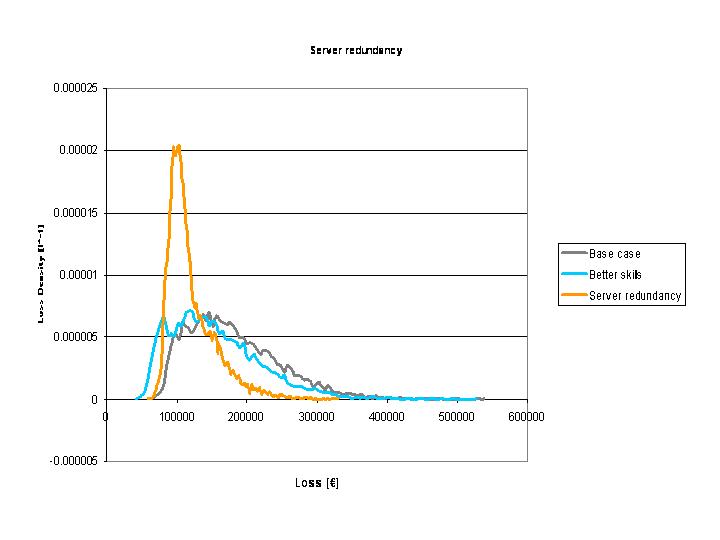
RISQSTOP Methodology RISQSTOP (Risk Quantification by Stochastic Processing) was developed by OpRiskSolutions and is based on the simulation of possible loss events which can occur while business processes of enterprises are executed. It includes the identification and quantification of operational risks and explicitly accounts for the interdependencies and causal relations between risk events, business areas and indicators. The risk management cycle has three phases: Model – Manage - Mitigate During the modelling phase, the business processes are enriched by quantitative and qualitative risk data. Often an existing business process documentation which was created with the ARIS-Software suite or comparable tools is the starting point for this. The modeled risks are simulated and quantified with the help of the RSL (Risk Simulation Language). The business processes and the operational losses which occur can be simulated over very long periods of time, i.e. several hundreds or even thousands of years. The result of these computations is the OPVAR (Operational Value at Risk) of the business unit under regard. The OPVAR is defined as the loss which will occur with a certain probability. With the aid of scenario analysis risk drivers can be identified and the influence of risk mitigation measures on the operational risk can be investigated. These computations enable the optimization of business processes and IT-Infrastructures under the aspect of operational risk. Investments in risk mitigation measures can be verified regarding their effectiveness and the ROI (Return on Investment) for risk investments can be determined.
|
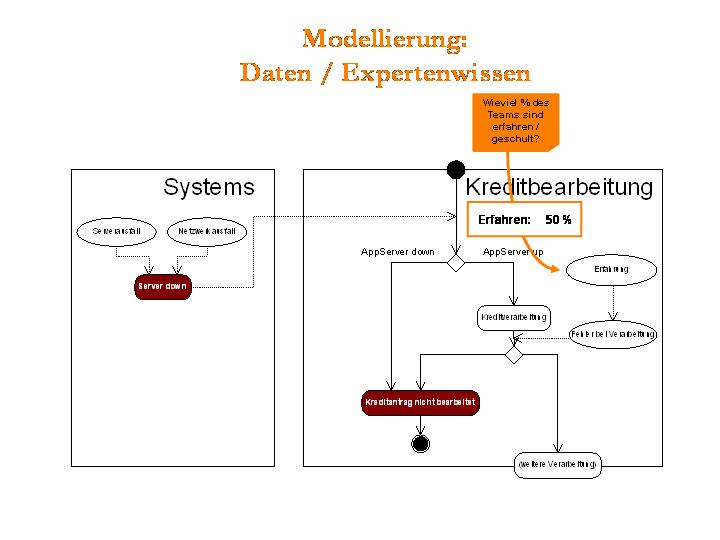
Modeling of Business
Processes and Enrichment with Risk Data
Comparing Loss distributions of
different Risk Mitigation Measures |
© OpRiskSolutions Ltd. All Rights Reserved