|
OpRiskSolutions Ltd.
model - manage - mitigate |
 |
|
| Home Company Solutions Services Training Partner Download Contact Impressum | Deutsch - English | |
|
-> RISQSTOP Methodology for Identification and Quantification of operational Risks
->Risk Cockpit |
Risk Cockpit The Risk cockpit is a Management Information system for the monitoring and management of operational risks. The user gets information on the level of measured risk values in relation to predefined trigger levels (which are based on the risk appetite of the organization) via a simple traffic-light logic (green= acceptable; yellow = critical; red = not acceptable). The rows of the “heat-matrix” are used for defining risk drivers, risk events or business processes and the columns are used to define consequences and effects which are a result of occurring risk events (i.e. cost, downtime etc.) Multidimensional views are possible, enabling the aggregation of risk information by business unit, organisational units or computing centre. The risk cockpit offers the user a multitude of additional information: trend information on the development of risk indicators over time, risk prioritization and suggestions on risk mitigation measures, information about risk owners and cumulated operational losses across business processes, organizational units or IT-Infrastructure areas. Additional documentation or emergency plans for certain risk events can be easily linked in. The display of information is tailored to the individual needs of the users and is based on a role-right model. Existing role-right models can be easily connected to the Risk Cockpit via standard interfaces. The Risk Cockpit is suitable for use as an alarm system for short-term changes of risks, for the management of risks on a medium-term timescale and as a tool for analysis and planning of long-term risk mitigation measures.
The Risk Cockpit is a very
flexible software solution which can be adapted easily to the needs of the
users. It has to be emphasized that it is not only suitable for Basel II,
but can also be used to support other compliance regimes like
Sarbanes-Oxley, ISO 7790 etc. By consequently using standards dependencies of the customers from OpRiskSolutions are avoided (no lock-in) and the protection of the investment is ensured.
|
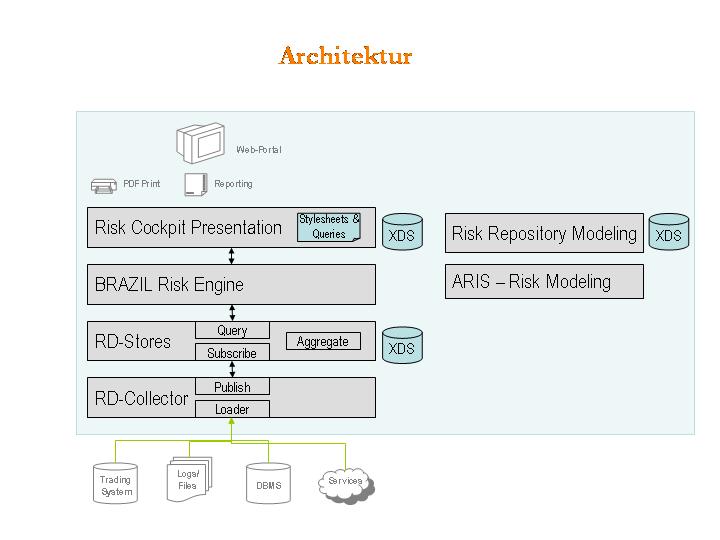 Risk Cockpit Architecture
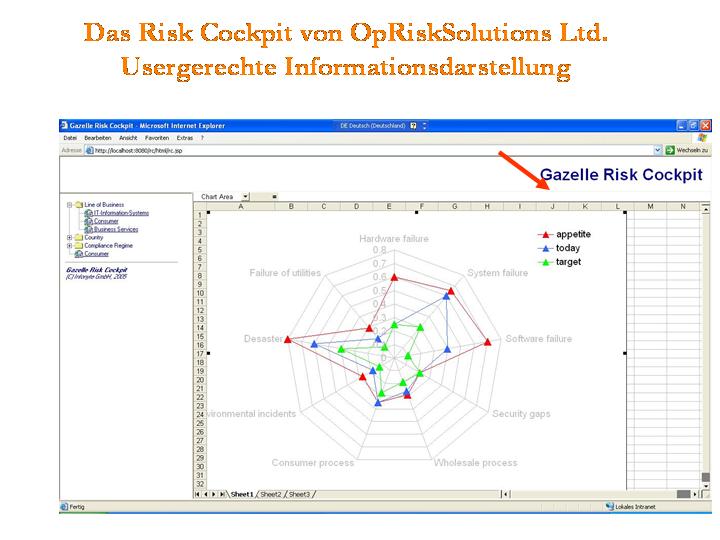
User-individual display of information |
© OpRiskSolutions Ltd. All Rights Reserved